
Automation
Sep 24, 2025
RFID Warehouse Management Without Replacing Your WMS: Integration, Auto-Check-Ins & ROI
Read more




In short: An automatic RFID check-in at goods receipt means the delivery is booked while it drives through the dock door. Pallets, wire mesh boxes and returnable containers carry passive UHF RFID tags. An RFID gate at the door reads all tags on a load in one pass, the system compares the reads with the expected delivery, and a terminal next to the gate confirms the check-in for the driver. Nobody has to walk around a pallet looking for a label. This guide walks through the check-in step by step, explains which hardware you need (tags, antennas, reader, gate), what works on metal load carriers, which radio rules apply in Europe, where barcodes still belong and what drives the cost. It is written by the SMAVOO sensor team. How the read events then reach your WMS or ERP is covered in our separate guide to RFID warehouse management.
An automatic RFID check-in is a goods receipt booking that happens because a tagged load passed a reading point, not because someone scanned it. The reading point is usually an RFID gate at the dock door: two pillars with antennas that create a reading field, plus a reader that collects every tag it sees. Each read is an event, "this tag was seen at this gate at this time", and the system turns those events into a booking.
The difference to a classic scan-based receipt is where the work happens. With barcodes, a person brings the scanner to every label. With RFID, the goods bring themselves to the reading point, and the forklift or pallet truck simply drives through. That is why RFID pays off most at doors with many deliveries, many load carriers per delivery, or load carriers that come back again and again.
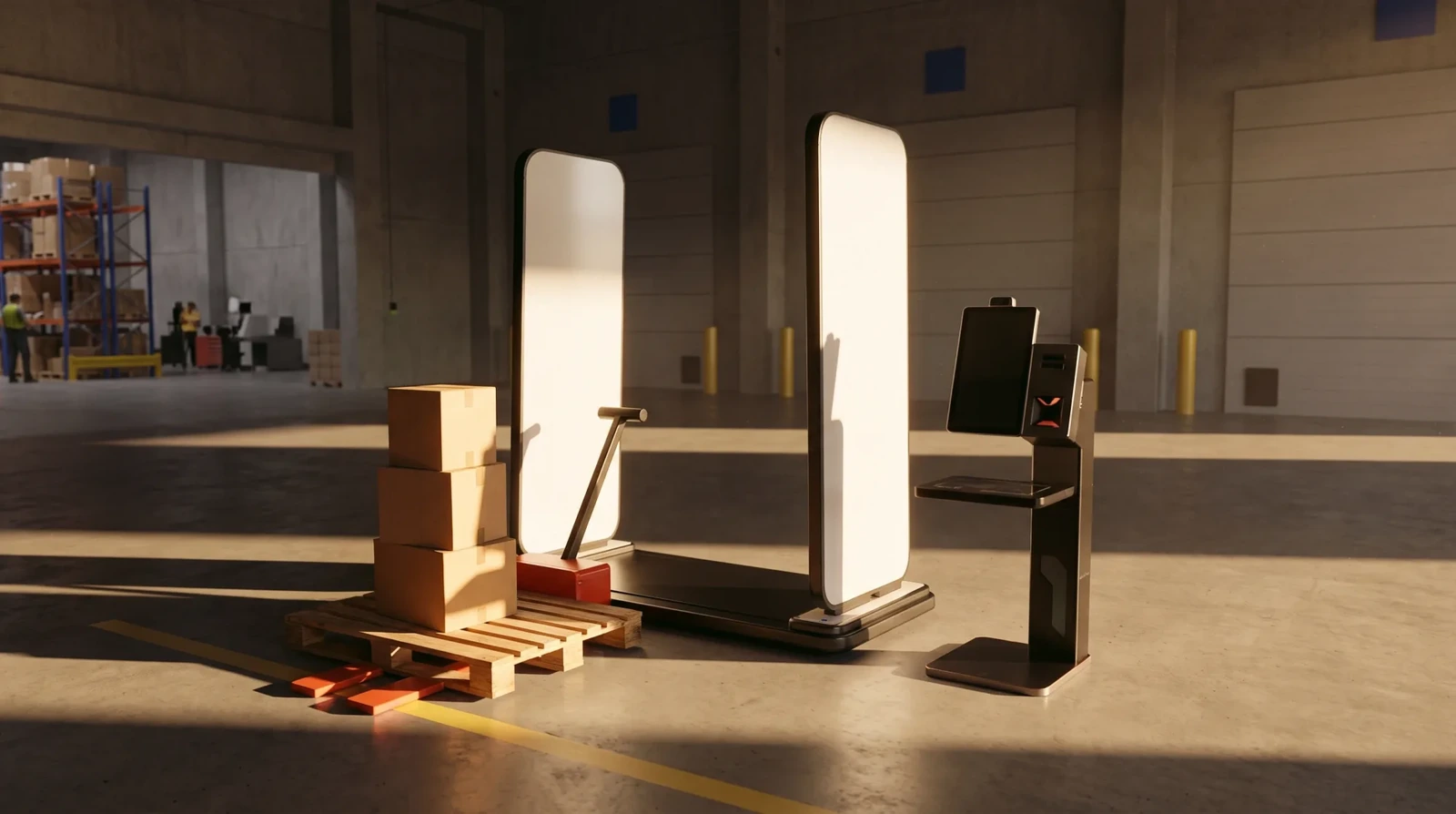
A pallet gets booked in five steps, and only the first one needs a human decision in advance.
The important part is step four. RFID doesn't make a wrong delivery right. It just shows the difference at the door, while the truck is still there, instead of two days later during put-away.
An RFID goods receipt needs four components: tags on the load carriers, antennas that shape the reading field, a reader that drives the antennas, and the gate structure with a terminal that turns the reads into a confirmed transaction.
| Component | What it does | SMAVOO example |
|---|---|---|
| UHF RFID tag | Carries the unique ID of the load carrier, needs no battery | On-Metal UHF RFID Tag for metal carriers, standard tags for plastic and wood |
| Antenna | Shapes the reading field at the door or conveyor | UHF RFID Antenna, 258 × 258 mm, 9 dBi linear or 12 dBi circular |
| Reader | Powers the antennas and collects the reads | UHF RFID 4-Port Reader: 4 antenna ports, more than 700 tags per second, read distance up to 30 m depending on antenna and environment |
| Gate and terminal | Frames the reading point and confirms the check-in | RFID Gate & Terminal with display and optional receipt printer |
Two details are easy to miss in planning. The reader has trigger inputs and relay outputs, so it can start reading when a light barrier fires and switch a signal light when the check-in is done. And the antennas decide where tags are read. A gate that also reads the pallets waiting two meters behind it causes more confusion than it solves, so antenna placement and power need a short site test before the rollout.
Yes, with the right tag. Standard UHF inlays lose much of their range when they sit directly on metal, because the metal interferes with the tag's antenna. That is the reason wire mesh boxes and metal pallets were a no-go for RFID for a long time.
On-metal tags solve this in their construction. The SMAVOO On-Metal UHF RFID Tag keeps the necessary distance to the surface in its own FR4 housing, is glued, screwed or riveted straight onto the metal, and reads at more than 5 m with fixed readers according to the datasheet. With IP68 protection and a size of 36 × 12 × 3.4 mm it also survives the daily life of a returnable container. Liquids behave similarly to metal, so for carriers with liquid content a quick read test is worth it before you order tags in volume.
One observation from our own work: in a customer project this summer, the same on-metal tags also read reliably on carbon-fibre parts. That makes sense physically, because carbon fibre is conductive too, but it is the kind of thing you only trust after you have seen it on your own parts.
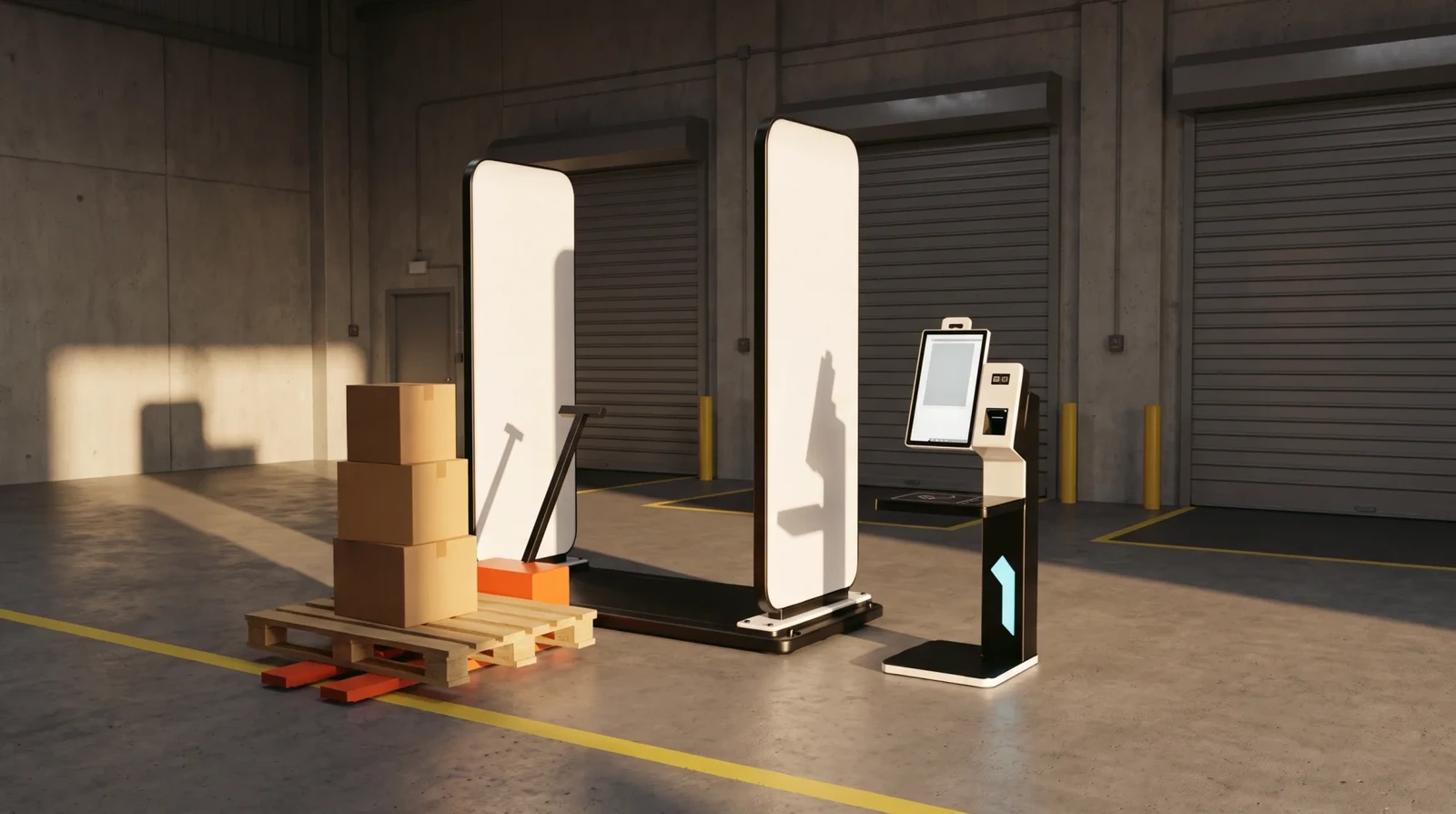
RFID gates rarely fail because of the technology itself. They fail because of the surroundings, and almost always in one of five ways. Knowing them before the rollout saves a lot of head-scratching afterwards.
None of these are exotic. They are simply the things a short site test is meant to find, which is why it belongs at the start of every project.
In Europe, UHF RFID readers work in the band from 865 to 868 MHz. The harmonised European standard ETSI EN 302 208 sets the conditions for this band, including power levels of up to 2 W. Readers sold in the EU are configured for exactly this band, which is also the case for the SMAVOO 4-Port Reader (865 to 868 MHz in its EU setting).
For the tags themselves, the common ground is the air interface standard EPC Class 1 Gen 2, also known as ISO 18000-6C. Tags that follow it can be read by readers from different manufacturers. For goods receipt this matters more than it seems, because the tag on a returnable container might be read at your door, at your supplier's shipping dock and at a logistics partner in between.
No, and in practice you shouldn't. RFID is strong where many load carriers pass one point and where the same carriers come back again and again. Barcodes are already printed on most goods coming from suppliers and cost nothing extra. The two work well together.
The automotive industry shows how that looks as a standard. The VDA recommendation 5501 on RFID in container management defines requirements for passive RFID transponders on returnable containers and at the same time recommends additional optical marking with plain text, barcode or DataMatrix code. So even the RFID standard assumes that a human or a scanner can still read the container when needed.
For the moments where a person handles individual items at the dock, for example opening a carton to check its contents, a hand-mounted scanner closes the gap. We describe that side in our guide to hands-free barcode scanning in the warehouse.
The cost of an RFID goods receipt depends on three drivers much more than on the gate itself: how many load carriers you have to tag, whether they come back, and how much integration your system needs.
We deliberately don't give a universal ROI figure here. What an automatic check-in saves depends on how long a manual receipt takes at your dock today, how often deliveries deviate and how many carriers go missing. The honest way to find out is to measure these three numbers for two weeks before you decide.
The gate's read events reach your WMS or ERP through an interface layer, so RFID sits next to the system you already run instead of replacing it. The gate collects the reads, the platform turns them into bookings and exceptions, and the existing system receives them like any other goods receipt.
Which interface fits, how to handle barcode and RFID side by side in the same system, and what a step-by-step integration looks like is the topic of our detailed guide to RFID warehouse management without replacing your WMS. This article stays at the door.
Start with one dock door and one type of load carrier. That keeps the pilot small enough to set up in a short time and big enough to produce real numbers.
If you want to see the other building blocks of automated material flow as well, the SMAVOO solution map shows every solution along the material flow, and this link opens it right at RFID in goods receipt.
A well set-up gate reads the tags on the load carriers reliably. Items packed deep inside a pallet, on metal or near liquids are harder. That is why most goods receipt setups tag the load carrier rather than every single item, and why a site test before the rollout is part of every project.
Not necessarily. Returnable containers that circulate between you and your suppliers can be tagged once by you. For one-way packaging, supplier tagging makes sense, but it can come in a second step.
That depends on the setup. Additional sensors such as light barriers, and the logic of which door is used for what, help the system assign a read to the right direction. It is one of the points we settle in the site test before a rollout.
UHF RFID in Europe works in the band from 865 to 868 MHz, regulated by the harmonised standard ETSI EN 302 208. Tags following EPC Class 1 Gen 2 (ISO 18000-6C) can be read by readers from different manufacturers.
Yes, usually. Most supplier goods already carry barcodes, and the VDA recommendation 5501 also calls for optical marking on RFID-tagged returnable containers. RFID takes over the bulk capture at the door, barcodes stay for single items and as a fallback.
A delivery that books itself while it drives through the door is one less thing to chase at the end of the shift. Curious what that would look like at your dock?
Every dock is different, so we start with your deliveries and your load carriers. Book a free 30-minute consultation with our team and we'll look at whether an RFID check-in pays off at your door.
A note on the images: scene images in this article were created or modified with AI for visualization purposes.
Lorem ipsum dolor sit amet, consectetur adipiscing elit, sed do eiusmod tempor incididunt ut labore et dolore magna aliqua. Ut enim ad minim veniam, quis nostrud exercitation ullamco laboris nisi ut aliquip ex ea commodo consequat. Duis aute irure dolor in reprehenderit in voluptate velit esse cillum dolore eu fugiat nulla pariatur.
Block quote
Unordered list
Bold text

Superscript
Subscript


